Minnemann Blues Band: pioneers of the blues in Portugal
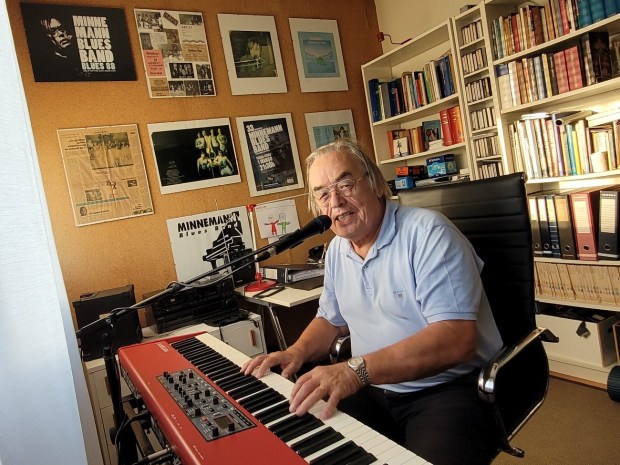
Wolfram Minnemann, leader of Minnemann Blues Band, playing keyboard at home. Porto, 27/09/2022 (photo: JP)
JOSEP PEDRO
Born in Hamburg in 1945, Wolfram Minnemann grew up in a musical family and soon developed a passion for music. Classically trained in piano, Minnemann was exposed to U.S. popular music, particularly jazz and blues, in the German post-war context that followed World War II. As a teenager, he was part of a traditional dixieland jazz band, Helenic Jazzband, as well as of a skiffle band, which typically performed traditional blues in acoustic line-ups. By 1968, he became involved in a progressive jazz-rock band called Thrice Mice, in which he played organ, piano and guitar. A representative of krautrock –a particular brand of experimental or cosmic German music–, Thrice Mice performed at the now mythical Love and Peace Festival in the island of Fehmarn (1970), along with artists such as Ginger Baker, The Faces, Peter Brötzmann, Mungo Jerry, Canned Heat, Sly & The Family Stone, Alexis Korner and Jimi Hendrix. They also recorded an homonymous album in 1971, which blended elements of classical music with jazz, blues and rock.
Minnemann moved to Portugal in 1973, and developed a career in the wine import business and in marketing and advertising. By 1978, he was playing blues and rock in with Rui Veloso –known as the father of Portuguese rock– and bass player Manuzé Carvalho. While Veloso successfully pursued his solo career, Minnemann became more specialized and dedicated himself to the blues. An energetic singer-pianist, Wolfram Minnemann has led the Minnemann Blues Band for more than 40 years. Based in Porto, this German-born, Portuguese blues pioneer has been a mainstay in the blues scene for decades, as well as an influential mentor for younger generations. Within the European context, his trajectory illustrates the intimate bonds between different U.S. popular music genres such as jazz, rock and blues. As a transnational musician, Minnemann also exposes first-hand the key role of migration and intercultural dialogue in the development of diasporic music scenes.
On 24 September 2022, during a research stay at the University of Porto to examine the blues and jazz scenes in the “capital of the North”, I was able to see the Minnemann Blues Band perform at the main local venue, Hot Five Jazz & Blues Club. I was there early, in the left corner of the first row. Wolfram arrived with a white motorbike helmet, which he left next to the piano. He took off his jacket, and wore his iconic black waistcoat. I saw the musicians going out to the patio, and I took my chance. I hung around them and took a look. Once I made eye contact with Minnemann, I went over to introduce myself as a Spanish researcher: “Estou a investigar as cenas musicais de blues e jazz no Porto...” He gave me a big smile and a welcoming grab. “Estás aqui en Porto?”, he asked. “Sim, até dezembro,” I affirmed. He then gave me his card so we could talk some other time. That night, as well as in our in-depth interview three days later, Wolfram Minnemann proved to be a knowledgeable, friendly and humorous veteran, a willing leader of the blues scene. On stage, he carried the audience from the start: “Are you ready for the blues? It’s blues tonight!”
The blues scene in Portugal
Without any explanation, you go to a village somewhere in Portugal and you play the blues, and people like it. You say: “Why? What has the blues to do with people of today?”
I have not found much written documentation about the history of blues in Portugal, but when I find something about it, you always appear at the beginning…
We are the oldest blues band in Portugal. We are playing for over 40 years already. A lot of guys call me father of the blues here in Portugal. Because I was in a sense the first to play blues, introduce blues, and therefore… It’s interesting. If you take the bands in Porto, you will see that, in nearly every band, one of the guys played with me. I am so fortunate that many bands started with my bands. Today, if you say Paulo Veloso [Delta Blues Riders], he played organ with me. If you say Peter Storm & The Blues Society, [Jorge] Oliveira was my drummer. I made this, and I’m okay with it. Now I’m old, too old to make new things.
How do you remember your arrival to Porto?
I came to Portugal during the dictatorship, in 1973. Then we had the revolution here in 1974. We had nearly no American music, only some commercial music. So blues was a quite unknown form of music. It’s interesting, the old guy, Mr. Salazar, who was the dictator, he even prohibited Coca-Cola. We were not allowed to drink Coca-Cola! [Laughs].
I came from Germany, as you read. I had a rock band over there. It’s called Thrice Mice. We used to do, let us say, German rock and roll, krautrock, which was a bit symphonic. [After that] I came to Portugal and played my piano at home. I brought the piano from Germany…
You did?
Yes! I must say, this piano is about 90 years old. It seems to be modern but it’s not. My grandfather was exporting beer from Germany to the United States. And within all these exports, he also started to export pianos. He had a big knowledge of pianos, and he ordered this piano for my mother. So it’s been in the family for 90 years!
How did you begin to perform music in Porto?
I was playing my boogie woogie and so on at home. Well, it’s really awful to always play alone. Then some friends of mine and friends of my wife, they knew a neighbor. He was living exactly on the other side of the street. So I met this guy called Rui Veloso, and today he is the best-selling singer in Portugal. Everybody knows Rui Veloso. But at the time [1978], he was not well-known. He played very good guitar. So we started to play the blues, only him and me. Then afterwards we get a bassman, Manuzé Carvalho, the same bassman who played the other day, and we started a band.
I started to develop my own music, and at that time Portuguese music was growing, even by law. It’s interesting. We had a law that forced the radio stations to play, I think at least 50% of Portuguese music, or music produced in Portugal. Of course, the editors were keen to get Portuguese bands, and so we made our first record. It’s a LP, by Minnemann & Amigos, and the title is Bluindo [Rádio Triunfo, 1982].
I made some Portuguese blues because the producers asked me. And it was very difficult. First of all, you have to understand how blues is made, how the text is, the whole construction of the text, and the blues logic. If this is not there, it’s not blues. So even if you sing it in Portuguese, you must follow that. In blues, you have AAB, right? A is a statement and B is the solution. There’s a response. So if you make a Portuguese blues you have to make the construction exactly like that. I had a friend who was a journalist at the Jornal de Notícias, and we worked together in order to get Portuguese texts. We made some blues about the fishermen who go out to the sea, and then somebody dies, and so on [“Blues Do Pescador”]. It’s about life, and it worked.

Wolfram Minnemann with Rui Veloso (harmonica) and Manuzé Carvalho (bass), Porto, 1978. (Photo: courtesy of WM)
How did your blues band evolve?
Rui [Veloso] started his own career as a singer. He then went to Lisbon. After Rui, I had several guitarists until I found António Mão de Ferro, who is the present guitarist and has been playing with us for about 20 years already. He has also already recorded about three records of his own. But unfortunately, records are not selling very well today. The music business is difficult, very difficult, because nobody, almost nobody, buys CDs. You buy music online, and online you have a million of other musicians offering music. So, it’s very difficult to get started as a musician. Today, even for the bigger bands, it’s economically better to concentrate on concerts than on records. Today, you’re producing a record to promote concerts. In the older times, you were playing concerts to promote the records…
The record was at the centre of the business…
Exactly. The money was in the records, and not in the concerts. Today, even the world-known bands are earning money on concerts, not on the records. It’s amazing.
Once you settled down here in Porto and met the rest of the of the guys, what was the reaction from Portuguese audiences?
We started to play all over the place: in all blues festivals in Portugal, and in blues festivals in Spain. We even went to Germany because, well, I’m German, so I organised a concert in Hamburg, my city, my birthplace. Then we went to another city, Brilon, and did a very large concert for a bank. Every year this local bank organises big cultural events for the clients and to promote the bank. This is interesting because you have direct help from economy to art. That’s very important.
It’s interesting with blues. Without any explanation, you go to a village somewhere in Portugal and you play the blues, and people like it. You say: “Why? What has the blues to do with people of today?” If you think it well, you can see that there are many people, many, many, who are not slaves, but in a sense, they are slaves. Yes, in a sense, they have the same feeling as the black people had in America. Because they live, for instance, oppressed at their jobs. Normally the companies have a hierarchy, a structure which has to do with oppression. And they have their difficulties in life and so on.
The interpretation of blues is erratic, even the name blues is erratic. Because blues, before it was called blues, people called it ditties, which is canções, songs. People were singing, moaning… Of course, we have the other side of the blues, the clerical side of blues is spirituals. Well that is a lot of moaning too… Blues is life. Spirituals are spiritual, but life is blues. This has to do with a word you have to note down, which is magara.
Magara comes from Africa, and we have to understand African culture if we want to understand blues. The meaning of magara is everything that is positive. So, love, sex, rich, home, comfort… It’s all positive, right? That’s magara. It comes from the primitive religions. These primitive religions have nothing to do with Christianism, they are older than that. It’s a religion where everything has life. Even the stones, the Earth. Everything is a creature. So magara is happiness.
Blues is a statement, which puts you in regard to happiness, to magara. You have three types of blues. The first is what everybody says: “this is blues”. I will cite a blues: “blues and trouble seem to be my best friend”. There’s no magara. It’s all negative. Another blues is: “I know how to get magara”: “I will go from the city, where I’m poor, and I will get back to the lowlands, to the country, and I will work in the fields and I will be happy.” And a third type is: “My baby rocks me with good old steady roll. I looked at the clock, clock struck one. My baby said: heavens on you”. What is that? This is a guy fucking. Then the second verse is: “My baby rocks me. I looked at the clock, clock struck two. My baby said: heaven’s on you.” The last verse is: “I looked at the clock, clock struck four. Bed broke down, and we finished on the floor”. This is “I have magara”.
You have blues when a guy sings that all his sexual power is immense, or things like that. That’s magara. You also have blues where I don’t have magara but I know how to get there. And there is blues where I don’t have magara and I never will.
I always say: “if I wouldn’t have had the music, I would already be dead today.” Blues has been my internal balance – Wolfram Minnemann
How would you describe the blues scene in Porto, as well as in other places in Portugal?
As you know, blues is very strong in Porto, stronger than in Lisbon. We have many bands here and we have less bands in the south. Then we have Braga… My son plays double bass and bass, and he plays with Budda [Guedes], Budda Power Blues and so on. He is the bass player.
We always had music in the family. So my son, Carl [Minnemann], first he studied international relationships and then he studied music conservatory, classical, double bass. Then ESMAE is very important for the development of music in Porto because it’s a school and you can graduate in music and jazz. This helps to develop a lot of new musicians.
He studied double bass, and now he is making lots of concerts. He’s teaching in the University of Aveiro. He’s teaching in this school where you can do the 12th grade in music. When he said: “I want to be a musician”, I said: “oh, God!” [Laughs]. But he’s living well.
So, it is possible to be a professional musician?
Yes, yes. It is possible.
I know Budda because he also collaborates with some Spanish musicians.
Yes, yes, yes. Whether the harmonica player, and so on.
Yes, Danny del Toro!
Yeah, I love Danny.
What about the venues here in Porto?
Unfortunately, we used to have two hot fives, one in the city, and the one you came to [uptown]. The one in the city, they tried to renew the building and they kicked them off. So, you only have this Hot Five [Jazz & Blues Club] here, which is a pity. We had another one, called Tribeca, where we also had live music and so on. But it closed some years ago, unfortunately. In Matosinhos there is a bar also with live music, but they only have cover bands there.
We had other small bars, but they didn’t survive. Of course, we had the two years with the pandemic where it was all shut down. It’s been very hard for venues and musicians, and also for all the staff. This was very, very tough because they had no work at all. Now things are getting better.
I noticed that there are quite a few festivals here in Porto, and that you have played at the Porto Blues Festival…
We have about five or six festivals per year in several places. For instance, now people have a festival in Braga, and so on. Step by step it’s growing, it’s growing.
The reason I planned this project was because I was seeing collaboration between musicians and producers from Portugal and Spain…
There is. For instance, we’ve met people in Braga, in Guarda, in Béjar, near to Salamanca… I performed at that festival [in 2009] and this was a cooperation between Guarda and Béjar. It was beautiful, and I love the Spanish public. Fantastic.

Wolfram Minnemann, Manuzé Carvalho, Miguel Sampaio and António Mão de Ferro: Minnemann Blues Band performing at the Hot Five Jazz & Blues Club. Porto, 24 September 2022 (photo: JP)
From Hamburg to Porto
One of the important things in my life was to meet Jimi Hendrix. We were very young at that time… For us, he was god. It was Jimi Hendrix’s last concert. He died about two weeks later.
Why did you move to Porto in 1973?
First of all, I have family here in Portugal. I had uncles and aunts here in Portugal. My father grew up in Portugal, here in Porto. I have to tell you the whole story. My grandfather emigrated from Germany to Brazil, to Rio Grande do Sul. He settled there and, together with some English friends, he was the founder of the first soccer club in Brazil. In 1900. He married a Brazilian teacher, then he went back to Germany around 1910. But in Germany they had the First World War, which ended in 1918. In Germany, it was poverty, hunger… It was impossible to live there. So, he decided to go back to Brazil; it’s a long trip, so he started going from Germany to Portugal.
Here in Portugal, my grandmother, this Brazilian grandmother, still had cousins in a small village –she was from Portuguese origin–, and the whole family went to this village. They stayed there for a half a year or something like that. Then they settled in Porto. So, my father was born in Germany, but he grew up here in Porto. Then he went to Hamburg, studied languages, and became a professor at the university in Hamburg. He also wanted us to learn Portuguese, so the first time I came to Portugal I was about six years old. Then with eight years old, ten, and so on, always during holidays. We spend our holidays in Portugal, and I loved Portugal. For me, it was a fantastic.
Very different to Hamburg…
Yes, the people, the climate, the food, everything.
In Hamburg I met my wife. She’s Portuguese, but she went there to learn German… [Laughs]. I met her there and I started to work in the wine business. I was responsible for the import of wines from France, Portugal, Italy… And within this, I met a man called Fernando Guedes. He was the founder of Sogrape, the biggest wine company in Portugal and possibly you will know Mateus Rosé. I was importing Mateus Rosé for my boss.
Well, we negotiated every year. He came to Germany to visit us and so on. I think in the fourth year he said: “you have to work with us in Portugal.” And I said: “well, that’s my chance! I will go to Portugal.” I took everything I had and came to Portugal. I came with my wife and started my family in Portugal, I have two sons.
So, I came to Portugal via wines. I later left, I was responsible for international marketing, so I was travelling all over the world. I mainly developed the Asian market, from Thailand to Singapore to Hong Kong, Japan, Australia… I was always travelling around: or starting a new agency for Mateus Rosé, or controlling the marketing of the agency there. But all this travelling, it’s really very hard to travel all the time. I thought: “I would like to have my own business”. So I started an advertising agency here in Porto, and this advertising agency I had for 35 years.
What was the name of the company?
WR. It’s my W from Wolfram and R from Rebus, my associate. It was all ups and downs. Because, as you know, advertising depends very much on the economy. If the economy is down, advertising is down. And if it’s up, it’s booming. But we managed to have the company 35 years.
Besides, I always was playing my piano and doing music. I always say: “if I wouldn’t have had the music, I would already be dead today”. Because advertising is so stressing. Every day is stressing, and then you have all the difficulties: the clients who do not pay, the payment to all the employees, and if you are at the end of the month you don’t know what to do…
And so you play the blues…?
Exactly! [Laughs]. I was playing the blues and it has been my balance, my internal balance.
How was the music scene in Hamburg?
As you know, we had the Second World War and then Germany was occupied by the Allies. Of course, Hamburg was the British zone, and then we have the American zone, the Russian zone and the French zone. Jazz was called nigger music in Germany, and it was not allowed to hear nigger music.
Verboten!
Verboten. When the Allies came in, of course, they occupied all the radio stations and started to play American music: blues, jazz. And if you were to go to Germany today, you would be astonished by how in every little place, in every city, you have blues and jazz. You have concerts all over Germany. People love jazz and blues because it was imported… Well, it was offered by the Allies and everybody loved the music. Of course, before that, in the twenties, they were dancing with Dixieland, swing and so on.
When the Nazi people started, it was forbidden to play this type of music. So people were hungry to listen to it. I grew up with American music, and it was more than normal. But I started to play classical piano at that time.
Your family was musical, right?
Yes. My mother was a fantastic opera singer. She died during the war. Even my grandfather used to sing and play piano. It’s interesting. When I started, I played Beethoven and so on. It’s all note by note. It’s like typing on a typewriter. You have the notes and pam, pam, pam, pam. I hated that. My teacher, fortunately, saw it and said: “You have to play other music”. He was, of course a classical pianist, but he used to play jazz in the bars of the Allies.
He said: “look, in the conservatory we have a room with two pianos, just like that. I play the harmony and you try to improvise. Then the other way around.” We started to play and suddenly music for me was heaven. I started to play jazz with him, and I started with boogie woogie, all these things on the piano. It’s fantastic. I had my first Dixieland band [Helenic Jazz Band] with 15. Afterwards, our clarinet player switched to saxophone and he invited me to participate in another band, in a rock band.
We made Thrice Mice and we played in all festivals. One of the important things in my life was to meet Jimi Hendrix. In Fehmarn, an island in North Germany, they wanted to do a Woodstock-like festival and they invited Jimi Hendrix, Canned Heat, Alexis Korner, and other bands. We played three bands before Jimi Hendrix. Fehmarn Love and Peace Festival, 4, 5 and 6 September, 1970.
Nice line-up!
We had a song called “Vivaldi”, which was very nice. It starts with a melody of Vivaldi, I don’t know exactly what Opus. And Jimi Hendrix said: “I like this music!” We of course were very young at that time… For us, he was god. It’s interesting. It was Jimi Hendrix’s last concert. He died about two weeks later. He was a very, very nice guy. The first thing he said was: “what are you earning in the bars? What are they paying?” [Laughs]. He wanted to know if we could live as musicians. This festival was something fantastic.

Thrice Mice – Thrice Mice! (Long Hair, 1971), krautrock experience
Style
Blues is a cultural mixture. It was the mother of everything. This new music conquered the world. Then you had English blues, Polish blues, Portuguese blues…
How do you face the writing process to do your own compositions?
In America, I went to libraries and I got old texts of blues without any [music] notes. Only the lyrics, transcripts. And I started to make music over all the texts. The music is all made by me. The texts I have from books of traditional texts. Very often there’s no author. I take the text, I read it and I imagine the music for the text.
When I listened to some of your songs, I noticed you were not strictly playing the 12-bar blues…
No, not at all. I have more changes. As everybody, I started playing the blues that everybody knows. But this is very boring, and it’s not your music. It’s the music of other guys. So I started my own blues. Of course, I had played jazz during a time, so I’m also accustomed to use other harmonies and so on. I saw that, even in blues, there are changes in harmony which are not the original Mississippi blues harmonies. I think you must have this freedom… So I do it.
What makes the blues different?
In the blues, in the classic chords, we have 12 tones. [In music] we have major and minor. Major is affirmative, strong. Minor is, well, weeping. It’s sad. In Africa they didn’t have these tonalities. They had tonalities that were similar to pentatonic. Africans didn’t understand the European music, so they tried to continue with their pentatonic scheme over the European scheme. With this mixture they created the blue notes, which are notes between minor and major. And this misunderstanding creates a new music. After this moment, all commercial music is played like this. It’s incredible, but it’s like that.
They started with it, and then jazz and every other music has blue notes. Today, for us, it sounds okay. But at the time it was not sounding okay. If you play a major chord and you play one blue note over it, it sounds bad. But if you play it in the melody, it sounds good. Because of this major/minor thing, people said: “oh, it’s blue, blue is sad… It’s blues.” And all people say: “oh, blues has to do with slavery…” It’s also not right. Because the blues started after slavery. Of course, after slavery, misery grew. Because the slaves were liberated, but now they had to pay for the lands. They had to rent the land to produce something. And normally, they won’t produce enough to pay the rent.
I notice that you are very interested in black culture. What are your feelings about this connection that blues and jazz have with black culture?
Well, first of all, it’s not only black. You can say its black music. But this music would never have been if these Africans wouldn’t have a seen the European music. So it’s a mixed music. It’s a music between white and black, music wise. Of course, there were black people playing it, but on half of the European music. Because otherwise they would have played their African music. And if you hear pure African music, it has nothing to do with blues.
Blues is a mixture, it’s a cultural mixture. And, of course, at the beginning we only had black people singing or playing the blues. But it was always a mixture between black and white music. The interesting thing is that this new music conquered the world. Everybody. If you now listen to the radio, you will have part of blues, because the blues was the mother of everything. It was the mother of rock ‘n’ roll, the mother of the commercial music, and so on. Blues is the origin of a new music in the world. Then you had English blues, you had Polish blues, you had Portuguese blues…

Wolfram Minnemann during the recording sessions of Bluindo, which represents his bond with Rui Veloso, o pai do rock português (source: Fonoteca Municipal do Porto)
What is your opinion on combining different genres? Of course, you said American music, but you changed from classical to jazz, then rock, blues…
The first band I made was skiffle, which is a form of simple blues. It’s played with washboard, banjo, and so on. Then it was Dixieland, and then I had a small swing quartet. But my soul was always blues. It’s nice to play swing, but it’s also complicated. Well, I prefer blues. So that’s why I stick on blues.
Was there any particular artist or musician at the time, which you admired the most?
No, I don’t have a direct idol. It’s very difficult because there are many good musicians. And, of course, I love a lot of musicians. I’m not the guy who sticks to the traditional blues, the Mississippi blues or whatever. Yes, my blues is more concert, it’s more open than other people play.
Unfortunately, it’s not possible to have a bigger band. My band during years was always five. With the saxophone player [plus piano, guitar, bass and drums]. I even thought I should have a saxophone and a trumpet to make the band thicker. But, on the other hand, the other day I went to a concert, a festival-type on open air, and I invited a saxophone player. Why? Because I had the money for it. If you have a band with six, seven, eight elements, you never can play it in the bar or whatever. Of course, in a big festival you can play. But normally it’s not possible.
So, I like to play the blues and not depend [economically] on music. My musicians, of course, they play in other places. I do that just for fun, and as a missionary for blues. I never lived off music, never. For me, playing the blues is to communicate the blues, and very often to explain what I’m singing…
Yeah, I loved that part because you introduced the different stories…
Exactly. Because very often, as it happens, you are singing and people are following. But they do not understand the lyrics. Of course, there’s a lot of slang. So the best is: you tell the story and then you sing the story.
What about the vocals? What process did you follow?
When I was very young, about ten, I started singing, like every blues musician, in the church.
I started to sing at a church in Hamburg, St Michael’s. It’s the most important church in Hamburg, and it has the most important choir. It’s known in all Germany, and they have a choir of only little boys. So I sang “St. Matthew’s Passion”, the oratorio from Händel, everything. All these clerical, classical things. We had teachers to learn how to pronounce, to learn how to sing, which was very good for me. It’s training the voice as a kid… And as a kid, you learn everything! [Laughs].
For me it was good because, I was 12, 13, and singing very well. The people proposed me this opera from Mozart, Zauberflöte, the magic flute, at the opera house. For me, it was: “Oh!” Well, two weeks later, I changed my voice! So I didn’t get to the opera house! [Laughs].
That’s funny.
And I had to go to the army after. I said, “well, I cannot take my piano with me, so I will take the guitar”. And I took a guitar with me without knowing how to play guitar. Then, of course, at the Army, it’s everybody shouting and so on… “Who comes here with a guitar?!” But the officer, he was also playing guitar. Fantastic. So we played together and I had a good time at the army!
Piano is a very demanding instrument. And if you play piano, it’s enough. But I can play guitar to sing, chords. That’s it, I’m not a guitar player. It was very interesting because, I was in North Germany at the Danish border, and I met other guys who were singing and we made a folklore band, with some guitars, singing Israeli folklore, Portuguese folklore and so on. We made some concerts in Denmark! Earning money too! But it was just for fun. So all my life I was singing.

Record selection: Minnemann & Amigos – Bluindo (Rádio Triunfo, 1982); Minnemann Blues Band – Blues 88. Live at Hot Five Jazz & Blues Club (Arteditores, 2010); Minnemann Blues Band – 40 Years (self-produced, 2019). Other recordings include Bluesiadas (1997), and a participation in VV.AA. – Festival de Blues em Lisboa 1997.
Blues and Fado
Lisbon fado talks about life, like blues. Of course, the musical ambience is completely different.
There’s a lot of discussion about the Portuguese identity, and some of it has to do with the word saudade, which is related to fado. I think it has a lot to do with melancholy, but perhaps also with magara… I’m thinking of the relationship between sadness and catharsis. Do you think there’s a bond between that feeling and blues?
It’s interesting, I felt that. Around the eighties or so, I produced a television programme and I invited a fado singer in order to talk about blues and fado. Blues normally has a simple harmonic structure and within this simple harmonic structure it’s possible to invent a text. You have the structure, everybody can play it, and so: “okay, let’s play in B major,” or something like that. They start, you start singing, and you can tell the story in a blues form. This is only possible because the harmonic structure is there. So the musicians are talking, right? And you can play or improvise a melody or a text over that. Or you can write a text and then sing it.
Well, with fado you also have standard harmonies. Everybody can play it, and you can sing above it. We have different fados. One type of fado is “Fado à desgarrada”. You have two singers and the guitar players, they play always the same. And then, I sing the statement and you will give the response. Of course, you have to rhyme it. But if these singers are good, they can tell their stories for half an hour. They sing over a harmonic structure which everybody knows! Then you have the romantic fado, which comes from Coimbra. It normally consists on adoring a girl, or something like that. And then you have the Lisbon fado, which is more blues-like. It is a fado that talks about life, like blues. Of course, the musical ambience is completely different.
So this is the similarity. The saudade has nothing to do with the feeling of blues. As I said, blues is my relation to magara, my relation to life, to happiness, sadness, or whatever. This is what I’m singing. I’m singing about catastrophes… And it’s dramatic. I have a blues about the floods, I’m singing about the floods in New Orleans… It’s a blues with no magara. Or another type of blues is: “I looked at the clock and…,” let’s go ahead! Saudade is a feeling of loss. I lost my love, my love is far away, and so I’m feeling saudade. I leave my country and I have saudade about my country. It’s more this type of positive sadness.
With Porto’s popularity growing so much, I see that some people love tourism and others are concerned…
Yes, yes. Porto is in, and Porto by night is something very special. I think you already went to the centre of the city by night. It’s incredible… The crowd. It’s very good because we don’t have any big industry. Porto is such a good place to live that today a lot of big companies come here. They even hire Portuguese people because they are well-trained. They settle here because Porto is a wonderful city, you have fantastic surroundings. You have river, you have sea, you have mountains. You have everything you want. It’s beautiful to live here.
In every big city you have tourism. If you go to Hamburg, to my city, there’s millions of tourists. If you go to Berlin, if you go to Paris, if you go to London… That’s normal. People move around with Ryanair, etc. It’s inevitable. I know that it will destroy a lot of our originality. But it’s the way the world develops. You can’t do nothing against it.
After all these years. Do you feel Portuguese?
Completely.
As much as you feel German?
No, no. I feel more Portuguese.

Brothers in arms, Wolfram Minnemann and Manuzé Carvalho have been playing the blues together since the late 1970s (photo: WM Facebook, 2014)
This interview was conducted on 27 September 2022 in Porto. Special thanks to Aitana Regueiro for her interest and contribution to the project.